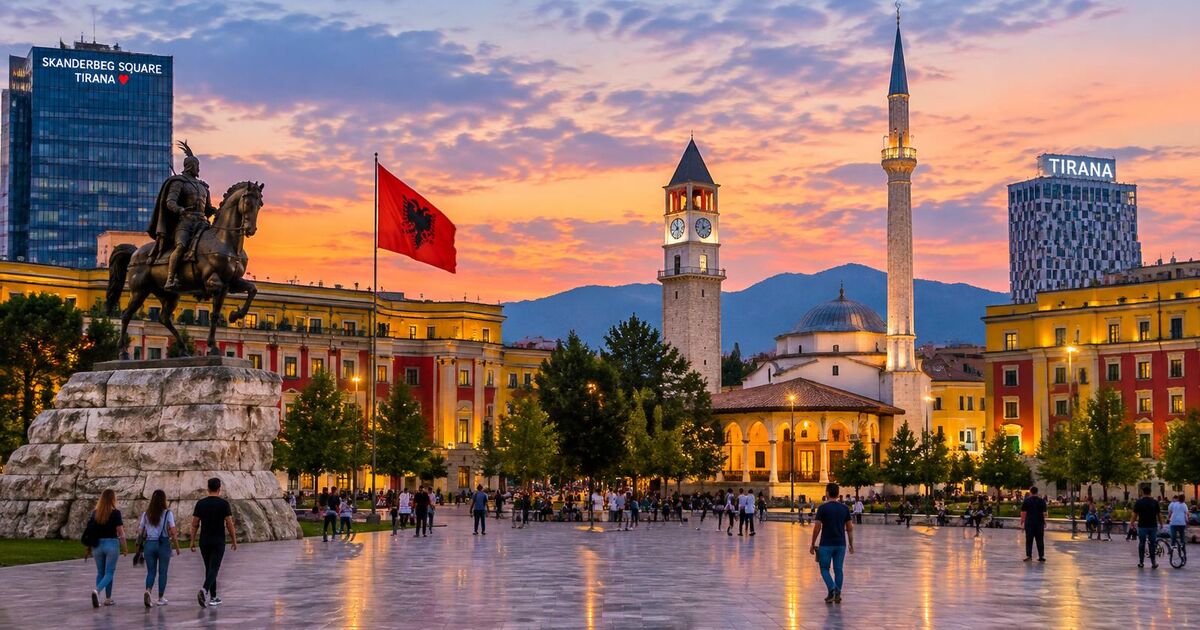
Skanderbeg Square & Et'hem Bey Mosque: Tirana Guide
Updated 2026-11-01 · 5 min read · Prices and schedules change — check locally.
How to Visit Skanderbeg Square and Et'hem Bey Mosque
- Arrive at central Tirana on foot, by city bus, or by taxi from your accommodation.
- Walk the perimeter of Skanderbeg Square to observe the National Historical Museum, the Palace of Culture, and the Clock Tower.
- Dress modestly with covered knees and shoulders before approaching Et'hem Bey Mosque.
- Remove your footwear at the entrance before stepping onto the carpeted prayer hall.
- Observe the floral frescoes and interior dome architecture quietly outside of daily prayer services.
What is the history of Skanderbeg Square?
Skanderbeg Square was designed during the Italian occupation in the late 1930s and expanded during Albania's communist period into a vast monumental space.
The square sits at the center of Tirana and honors Gjergj Kastrioti Skanderbeg, the 15th-century military commander and national hero of Albania. His bronze equestrian statue, erected in 1968, marks the focal point. During the communist regime under Enver Hoxha, surrounding historic Ottoman structures were demolished to make way for large socialist-realist buildings, including the Palace of Culture and the National Historical Museum.
In 2017, the square underwent an extensive renovation that converted 40,000 square meters into a pedestrian zone. The pavement was paved using natural stone slabs quarried from all regions where ethnic Albanians live, including Albania, Kosovo, and North Macedonia. The surface includes small fountains that use recycled rainwater to cool the plaza during hot Mediterranean summers.
| Feature | Details | Visitor Notes |
|---|---|---|
| Skanderbeg Statue | 11-meter bronze monument erected in 1968 | Central meeting point and photo location |
| Pavement Design | Natural stones from across the Albanian regions | Pedestrian-only surface with cooling water features |
| Clock Tower (Sahat Kulla) | Built in 1822; 35 meters high | Stairs open to visitors for city views |
| Et'hem Bey Mosque | Constructed between 1791 and 1821 | Active place of worship; open between prayers |
Why is Et'hem Bey Mosque architecturally significant?
Et'hem Bey Mosque is known for rare exterior and interior Ottoman frescoes depicting natural landscapes, waterfalls, and trees, motifs unusual in Islamic art.
Construction of the mosque began around 1791 under Molla Bey and was completed in 1821 by his son, Haxhi Et'hem Bey. The building consists of a single prayer room, a square hall covered by a dome, and an outer portico supported by stone pillars. The portico and exterior walls feature decorative artwork showing stylized trees, bridges, and domestic structures, which was influenced by late Ottoman Baroque and regional decorative traditions.
The mosque survived the anti-religious campaigns of the 1960s, during which the communist regime destroyed hundreds of churches and mosques across Albania. It was preserved as a cultural monument due to its artistic value. On January 18, 1991, thousands of citizens gathered at the mosque to worship in defiance of the communist government, an event recognized as a pivotal moment in Albania's transition to democracy.
What are the visitor guidelines and etiquette for Et'hem Bey Mosque?
Visitors of all backgrounds may enter Et'hem Bey Mosque free of charge outside regular prayer times, provided they dress modestly and remove their shoes.
Because Et'hem Bey Mosque is an active place of worship, visits are paused during the five daily prayer calls. Female visitors must cover their hair, shoulders, and legs, while male visitors should wear trousers covering the knees. Headscarves and wraps are often available at the entrance for guests who require them, but carrying your own scarf is recommended.
All footwear must be removed and placed on the wooden shoe racks at the entrance before stepping onto the prayer rugs. Photography is permitted, but visitors must turn off camera flashes and refrain from photographing worshippers. Speaking in a low voice is required at all times inside the prayer hall.
| Requirement | Rule | Recommendation |
|---|---|---|
| Footwear | Must be removed before entering carpeted areas | Wear slip-on shoes for convenience |
| Women's Attire | Cover hair, shoulders, and knees | Carry a light shawl or scarf |
| Men's Attire | Cover shoulders and knees | Wear trousers rather than shorts |
| Timing | Closed to tourists during active prayer calls | Visit mid-morning between prayer times |
| Photography | Permitted without flash or tripods | Do not point cameras at individuals praying |
What other landmarks surround Skanderbeg Square?
The square is bordered by the National Historical Museum, the Palace of Culture, the Clock Tower, City Hall, and several historic government ministries.
North of the square stands the National Historical Museum, identifiable by its massive socialist-realist mosaic facade titled 'The Albanians.' To the east lies the Palace of Culture, which houses the National Theatre of Opera and Ballet and the National Library. Directly adjacent to Et'hem Bey Mosque is the 35-meter-tall Clock Tower (Sahat Kulla), built in 1822, which visitors can climb for views over the central district.
The southern end of the square features yellow and salmon-colored administrative ministries designed by Italian architects Florestano Di Fausto and Armando Brasini in the 1930s. These neoclassical and rationalist structures now house the Ministry of Infrastructure, the Ministry of Economy, and Tirana City Hall. Continuing south from here leads visitors onto Dëshmorët e Kombit Boulevard toward the Bunk'Art 2 museum and the Grand Park.
| Surrounding Site | Function | Approximate Entry Fee (EUR / ALL) |
|---|---|---|
| National Historical Museum | National heritage exhibits | Prices change: 4-6 EUR (400-600 ALL) |
| Clock Tower (Sahat Kulla) | Historic viewpoint | Prices change: 2-3 EUR (200-300 ALL) |
| Bunk'Art 2 | Underground communist history museum | Prices change: 5-7 EUR (500-700 ALL) |
| Palace of Culture | Opera and theater venue | Free exterior; ticket prices vary by event |
How do you get to Skanderbeg Square and what are the visiting costs?
Skanderbeg Square is accessible on foot from anywhere in central Tirana, and entry to both the plaza and Et'hem Bey Mosque is free.
Most visitors staying in central Tirana can reach Skanderbeg Square on foot within 5 to 15 minutes. City bus lines serving various neighborhoods and the central train and intercity terminals stop along the streets directly adjacent to the square. A single city bus ticket costs 40 ALL (around 0.40 EUR, prices change). Taxis from the airport to the square generally cost between 15 and 25 EUR (1,500 to 2,500 ALL, prices change).
Walking across Skanderbeg Square is free and open 24 hours a day. Entry to Et'hem Bey Mosque does not require a mandatory ticket, though small donations ranging from 1 to 3 EUR (100 to 300 ALL, prices change) are welcomed to support maintenance and site conservation. Bring cash in Albanian lek, as card terminals are not standard for small donations or nearby kiosk purchases.
| Service / Entry | Cost Range (EUR) | Cost Range (ALL) |
|---|---|---|
| Skanderbeg Square access | Free | Free |
| Et'hem Bey Mosque entry | Free (optional donation 1-3 EUR) | Free (optional donation 100-300 ALL) |
| Local city bus fare | Approx. 0.40 EUR | 40 ALL |
| Airport taxi to square | 15-25 EUR | 1,500-2,500 ALL |