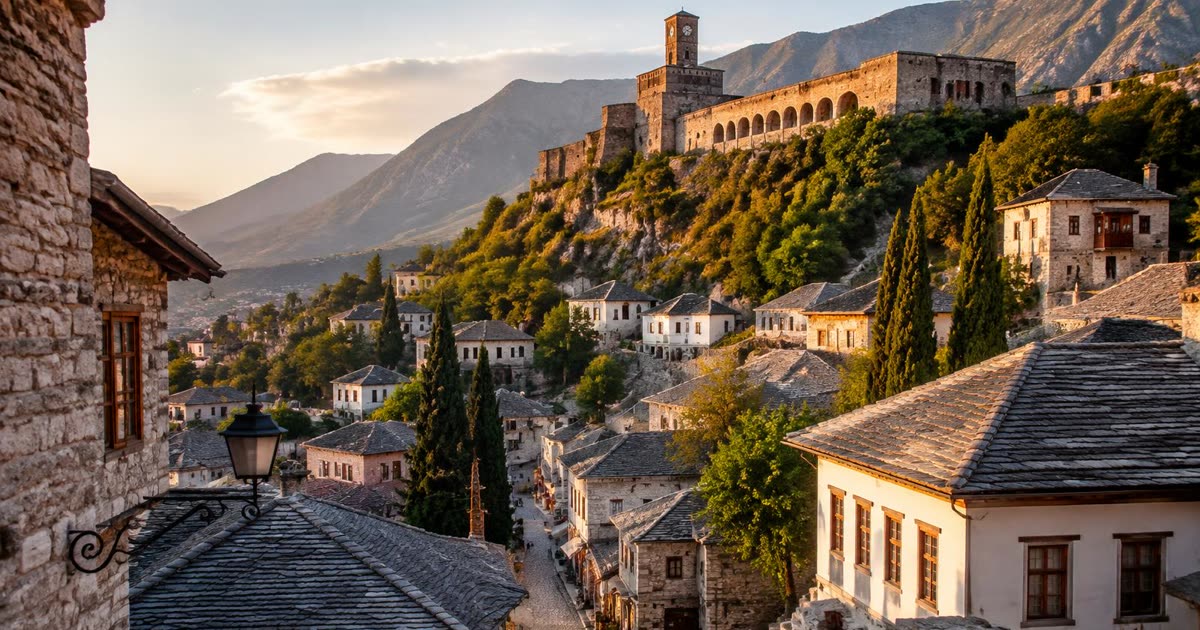
Ottoman Houses of Gjirokastër: Skenduli and Zekate Guide
Updated 2026-11-01 · 5 min read · Prices and schedules change — check locally.
How to Visit Skenduli and Zekate Houses
- Walk uphill from Gjirokastër's Old Bazaar along the stone-paved streets toward the Palorto neighborhood.
- Visit Skenduli House first, located near the Ethnographic Museum, and pay the cash entry fee at the gate.
- Follow the uphill cobblestone path for approximately 10 to 15 minutes to reach Zekate House at the top of the Palorto quarter.
- Ring the bell at Zekate House so the resident caretaker can unlock the doors and collect the admission fee.
- Climb to the top-floor guest reception rooms (oda) in both properties to inspect the wood-carved ceilings and original wall paintings.
What makes Zekate House unique in Gjirokastër?
Built between 1811 and 1812 for Ali Pasha's accountant Beqir Zeko, Zekate House is the grandest fortified twin-tower residence in Gjirokastër.
Zekate House stands at the highest point of the Palorto neighborhood, designed as an impenetrable private fortress. The lower two levels are built of thick, unadorned stone blocks with narrow arrow slits for defense, containing water cisterns, animal stables, and grain storage. This fortified base protected the family against regional banditry and political rivalries common in the Epirus region during the early nineteenth century.
The third and fourth floors transition into living quarters with arched galleries connecting the two dominant towers. The main reception room on the top floor represents the high point of Gjirokastër civic architecture, containing ornate carved wooden ceilings, an open fireplace, stained-glass windows, and frescoes depicting cities and landscapes of the Ottoman Empire.
What can you see inside Skenduli House?
Skenduli House features 64 windows, 44 doors, 9 fireplaces, and 6 bathrooms, making it the most structurally complex domestic Ottoman residence in the city.
Constructed around 1823 for the Skenduli family, who were prominent landholders, this house illustrates the wealth of Gjirokastër's merchant class. Unlike Zekate House, Skenduli was modified multiple times across generations. It retains internal features such as a dedicated marriage chamber with pomegranate and floral ceiling carvings, ventilation shafts, and separate interior quarters designed for different seasons.
During the communist era, the mansion was nationalized and operated as the city's ethnographic museum before the building was restored to the Skenduli family in the 1990s. Descendants of the original owners frequently guide visitors through the rooms, pointing out original household objects, hidden defensive trapdoors, and historical family documents.
How do Skenduli House and Zekate House compare?
Zekate House emphasizes military defense and monumental symmetry with its twin stone towers, while Skenduli House provides a deeper look at private domestic life through a larger variety of rooms and fireplaces.
Both properties follow the classic Balkan kulla typology of stone ground floors topped by timber-framed living quarters. Zekate House offers more dramatic exterior architecture and elevated views across the Drino Valley because of its ridge position. In contrast, Skenduli House sits lower on the hillside and preserves a more detailed labyrinth of functional spaces, including private hamam-style washrooms and separate bread-baking rooms.
Visiting both houses provides a complete understanding of Gjirokastër's UNESCO World Heritage domestic architecture. Travelers short on time often choose Zekate for its sheer scale or Skenduli for its central location near the bazaar and guided walk-throughs by the owner.
| Feature | Skenduli House | Zekate House |
|---|---|---|
| Construction Date | Circa 1823 | 1811–1812 |
| Original Owner | Skenduli Family (Landowners) | Beqir Zeko (Administrator for Ali Pasha) |
| Architectural Type | Multi-winged Ottoman mansion | Twin-tower fortified kulla |
| Notable Detail | 64 windows, 9 fireplaces, painted wedding room | Double arched loggia, frescoed main reception room |
| Walking Time from Bazaar | 10–12 minutes uphill | 20–25 minutes uphill |
How much is admission to Skenduli and Zekate Houses?
Admission to each house typically ranges from 200 to 300 ALL (approximately 2 to 3 EUR) per person, payable strictly in cash.
Both houses are privately owned and operated, meaning standard municipal museum passes do not apply. Entry tickets cost between 200 and 300 ALL (around 2 to 3 EUR) per house, though prices change over time. Small bills in Albanian lek are recommended, as caretakers rarely have card terminals or large amounts of change.
There are no strict digital ticketing systems. During daylight hours, caretakers or family members remain on-site or leave contact numbers posted on the entrance gate. Tipping is customary if a family member provides an informal spoken tour of the interior rooms.
What is the best route to walk between Skenduli and Zekate?
The walk between Skenduli House and Zekate House takes 10 to 15 minutes along steep, stone-paved streets in the Palorto quarter.
The streets of Gjirokastër are paved with traditional limestone cobbles (kalldrëm) arranged in geometric black-and-white patterns. These stones become slick when wet, and the incline between the lower Palorto district and Zekate House is steep. Footwear with good traction is essential for walking between the two sites.
A logical itinerary starts at the Old Bazaar, heads northwest to the Ethnographic Museum and Skenduli House, and continues climbing uphill along Rruga Zejtareve toward Zekate House. After completing both houses, visitors can descend via the lower pathways leading toward the Gjirokastër Castle or return directly to the bazaar for refreshments.