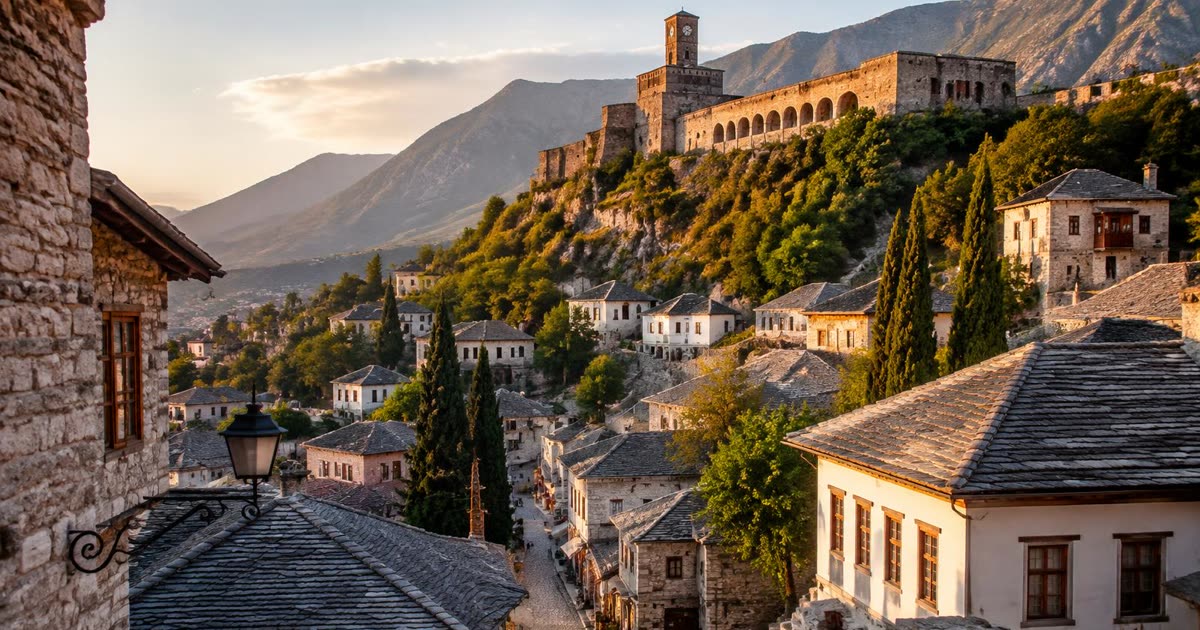
Things to Do in Gjirokastër: Complete Stone City Guide
Updated 2026-11-01 · 6 min read · Prices and schedules change — check locally.
How to Spend One Day in Gjirokastër
- Walk up through the Old Bazaar along the limestone cobblestone paths toward the fortress.
- Tour Gjirokastër Castle, viewing the arms museum, the clock tower, and the military aircraft.
- Descend to the central square for a guided tour of the underground Cold War Tunnel.
- Visit Skenduli House or Zekate House to inspect traditional multi-story Ottoman architecture.
- Dine in the historic bazaar area to try regional specialties such as pasha qofte and shapkat.
What should you see inside Gjirokastër Castle?
Gjirokastër Castle contains an extensive arms museum, a historic clock tower, stone vaulted galleries, and a captured United States Air Force jet.
The fortress sits on a ridge above the city and dates in parts to the 12th century, with major expansions completed under Ali Pasha of Tepelenë during the Ottoman era. Visitors enter through stone vaulted passages that lead past an artillery gallery featuring German and Italian field guns from World War II. The open courtyard features a clock tower overlooking the Drino Valley and an intact Lockheed T-33 jet forced down by the Albanian military in 1957.
The interior museum houses weaponry spanning medieval skirmishes to modern conflicts. Entry to the main castle grounds typically costs between 400 and 600 ALL (roughly 4 to 6 EUR), with an optional extra ticket required for the dedicated weapons museum. Because ticket policies and rates adjust over time, prices change. Wear walking shoes with traction, as the stone ramps inside the castle are steep and worn smooth.
Which historic Ottoman houses can you tour in Gjirokastër?
Zekate House and Skenduli House are the best-preserved Ottoman tower houses (kulla) open to visitors in the historic center.
Zekate House, built between 1811 and 1812, stands high in the Palorto neighborhood. This fortified house features dual towers, whitewashed upper levels, and an ornate top-floor reception room decorated with fresco murals, carved woodwork, and a raised seating divan. Its design reflects the defensive needs of wealthy Ottoman administrators, including ground-floor stone cisterns, arrow slits, and separate quarters for men and women.
Skenduli House sits closer to the town center and preserves original structural woodwork, multiple fireplaces, and a distinct hamam (indoor bath). Family members often guide visitors through the multi-room complex, explaining the functionality of its structural arches and domestic layouts. Admission to each house is generally collected at the door and ranges from 200 to 300 ALL (around 2 to 3 EUR; prices change).
What is the Cold War Tunnel in Gjirokastër?
The Cold War Tunnel is an underground nuclear bunker complex constructed beneath the castle in the 1970s for local Communist leadership.
Built under the regime of Enver Hoxha, this reinforced concrete subterranean shelter extends for hundreds of meters through 59 distinct rooms. The complex was designed to function autonomously during a chemical, conventional, or nuclear attack, complete with air filtration rooms, power generators, decontamination zones, meeting spaces, and administrative offices.
Visits inside the bunker require a local guide due to the lack of interior natural light and the labyrinthine layout. The entrance is located on the street level behind the former town hall near the main bazaar. Standard entry tickets cost between 200 and 400 ALL (around 2 to 4 EUR; prices change). Visitors should bring a light layer of clothing, as temperatures underground remain cool year-round.
What are the best day trips from Gjirokastër?
Top day trips within an hour's drive include the thermal waters of Benjë near Përmet, the Blue Eye natural spring, and the Antigonea archaeological park.
Përmet is located approximately one hour northeast and offers the stone Kadiut Bridge spanning the Lengarica Canyon, alongside the Benjë thermal baths. To the south, the Blue Eye (Syri i Kaltër) is a freshwater spring located on the road toward Sarandë. Hikers and history enthusiasts can also travel across the Drino Valley to Antigonea, an ancient city founded in 295 BC by King Pyrrhus of Epirus.
Most regional destinations are reached by private car or local shared minibuses (furgons) leaving from the lower transport terminal in Gjirokastër. Travel times vary by road condition and season.
| Destination | Distance | Key Feature | Typical Travel Time |
|---|---|---|---|
| Antigonea Archaeological Park | 14 km | Hellenistic ruins and stone ramparts | 30 minutes |
| Blue Eye (Syri i Kaltër) | 35 km | Deep karst freshwater spring | 45 minutes |
| Benjë Thermal Springs (Përmet) | 60 km | Ottoman bridge and sulfur pools | 1 hour 15 minutes |
How do you get to Gjirokastër and get around the city?
Gjirokastër is accessible by road from Tirana and Sarandë, while exploring the historic old town is done exclusively on foot.
Regional buses and furgons connect Gjirokastër directly to major hubs. Travel from Tirana takes roughly four hours along the national highway, while buses from the coastal city of Sarandë take around one hour. Long-distance buses drop passengers in the modern lower town along the SH4 roadway. From there, local city minibuses or taxis transport travelers up the hillside to the Old Bazaar.
The historic neighborhoods are paved with black-and-white limestone cobbles laid out in decorative geometric patterns. Vehicles cannot navigate the narrowest lanes, and parking in the old center is restricted. Sturdy footwear is necessary, as the steep stones become slippery when damp.